Included with the book
Sensemaking Studio
Choose one of the eight instruments, add one prompt and one signifier of each type, and begin with a classroom, cohort, or first real-world run.
Most people begin with Sensemaking Studio (free with the book), Inquiry ($49/mo), or Praxis ($129/mo billed annually, $1,548/yr, or $149 monthly). Start here to practice with the book, gather stories across a broad audience, or facilitate collaborative team decision rooms.
Not sure which context you are in? Run the orientation — it asks about your situation and lands you on the plan that fits your context.
Choose the lightest path that still fits.
Included with the book
Choose one of the eight instruments, add one prompt and one signifier of each type, and begin with a classroom, cohort, or first real-world run.
Ask many people
One story prompt across many people, each interpreting their own experience. Design the instrument yourself, or commission one.
Collaborative practice
Use this when teams or consulting groups make sense together — with 9 interactive Decision Rooms, story decks, and shared interpretation.
If procurement is part of the decision
Use this when assurance, data residency, or a DPA is what defines the work — it is scoped and quoted with you rather than bought from a card.
If you want the method-first path, start here. These eight companion articles explain the full rhythm: invitation, discovery, design, hosting, interpretation, action, and ongoing capability.
Step 1: Initiating Inquiry
Sets starting conditions for learning in complexity by clarifying purpose, inclusion, and safe participation commitments.
Read articleStep 2: Collaborative Discovery
Frames the full eight-phase scaffolding so teams can move from inquiry to wise action without collapsing nuance.
Read articleStep 3: Crafting Inquiry Tools
Shows how bounded framing protects candor, supports coverage, and keeps interpretation governable.
Read articleStep 4: Enabling Pattern Insight
Treats patterns as hypotheses to investigate, not conclusions to announce, using bounded comparisons and story-linked context.
Read articleStep 5: Collective Interpretation
Keeps interpretive authority with participants so meaning remains grounded in lived context.
Read articleStep 6: Adaptive Action and Experimentation
Shows how release timing and format shape the next cycle of participation, interpretation, and action.
Read articleStep 7: Learning from Results
Designs role-based visibility and thresholds so learning can travel without breaking candor or integrity.
Read articleStep 8: Building Ongoing Capability
Distills the operating principles that keep studies credible over time in complex adaptive systems.
Read articleIf you want a ready-made place to begin from Designing Sensemaking Studies, this route gives you eight predesigned instruments to choose from, one at a time, inside the same studio flow.
Stay here if the book is your starting point. Run the orientation when the work sits on behalf of an organization, nonprofit, government body, public program, or quasi-government setting — it will point you at the plan that carries that weight.
Run the orientationPurchase confirmation opens Studio: one instrument chosen from the eight, one added prompt, one signifier of each type, and one shared results page for classroom, cohort, or first real-world use.
You move from stories, to interpretation, to a written checkpoint your team can return to when decisions change.
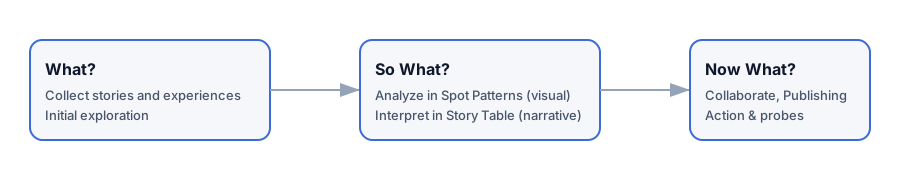
These eight predesigned instruments are included with the book. Begin with one now, then return for another when the work is ready for it.

Build coherence before external action.
Included with the book
Private reflection on identity, tension, and next-wise choice under pressure.
When you are ready, compare:

Review shared work without turning learning into blame.
Included with the book
A safer retrospective loop for conditions, blockers, and collective learning without blame.
When you are ready, compare:

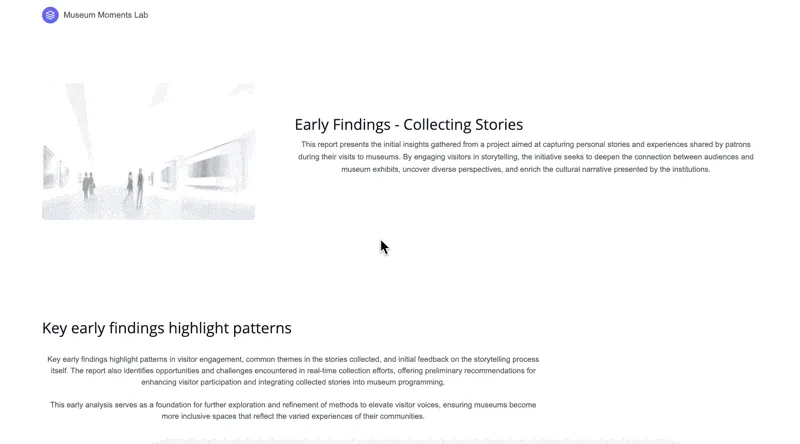
Capture what mattered in the experience without flattening interpretation.
Included with the book
Open-call audience listening that captures what mattered and where inclusion shaped the experience.
When you are ready, compare:
Need something beyond the Studio instruments? Explore pricing & plans or browse use cases.
How leaders use stories and weak signals to improve judgment in complex systems.
Read articleHow to engage broad participation without flattening lived experience.
Read articleHow narrative patterns reveal what dashboards and surveys often miss.
Read article